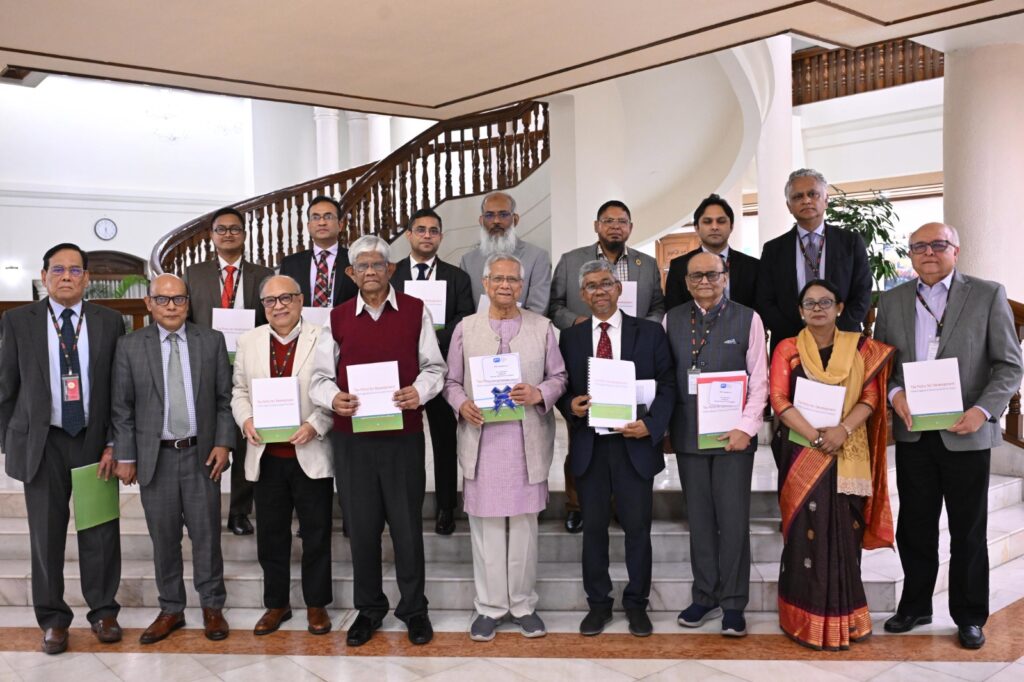
The National Taskforce on Restructuring the Tax System submitted a report titled “Tax Policy for Development: A Reform Agenda for Restructuring the Tax System” to Chief Adviser Professor Muhammad Yunus on 27 January, 2026. The report proposed necessary restructuring of the tax system with the aim of raising the tax-to-GDP ratio to the desired level and formulating tax policies to support the country’s overall economic development, including domestic and foreign trade.
A ten-member task force led by its Chairperson, Dr. Zaidi Sattar, Chairman of Policy Research Institute of Bangladesh (PRI), handed over the report to the Chief Adviser at the State Guest House Jamuna.
Finance Adviser Dr Salehuddin Ahmed, Economic Relations Division (ERD) Secretary Md Shahriar Kader Siddiky, Finance Division Secretary Dr Md Khairuzzaman Mozumder, Financial Institutions Division Secretary Nazma Mobarek, and Internal Resources Division Secretary and NBR Chairman Md Abdur Rahman Khan, were present on the occasion.
To accelerate and sustain Bangladesh’s economic progress as a developing country, increasing the government’s own revenue income is essential, with the tax system being its most important component. However, Bangladesh’s current tax structure suffers from various limitations. In this context, an 11-member National Task Force was formed on October 6, 2025, under the leadership of Dr. Zaidi Sattar to achieve the desired revenue collection and raise the tax-to-GDP ratio to an acceptable level.
The Task Force was given a deadline of January 31, 2026, to submit a report recommending necessary restructuring of the tax system and specific short- and long-term actions. Accordingly, at 5:00 PM on January 27, 2026, the members submitted the report to the Chief Adviser.
The report describes Bangladesh’s tax system as unnecessarily complex, inefficient, and overly dependent on indirect taxes.
It states that instead of minor reforms or piecemeal changes, fundamental and structural reforms are required to ensure long-term economic prosperity.
The report covers three broad tax segments: Direct Tax (comprising personal income tax, corporate income tax, and property tax), Value Added Tax (VAT), and Trade Tax (tariff and para-tariff).
The report identifies 55 policy issues and provides recommendations for each. It highlights seven priority policy areas and presents a roadmap to increase the tax-to-GDP ratio from 10 percent to 12 percent by 2030, and from 15 percent to 20 percent by 2035. It also proposes restructuring the direct-to-indirect tax ratio from 30:70 to 50:50.
Furthermore, the report recommends digitization, automation, AI-based risk analysis, a simplified tax structure, restructuring of incentives, risk-based audits, and a strategic shift from trade taxes toward domestic taxes. Regarding the modernization of the tariff structure, it suggests equalizing effective protection for export and import substitute products.
The report also notes that there is no need for a separate valuation database for customs clearance and recommends implementing post-clearance audits instead of port-based checks, with full implementation of ASYCUDA, which contains links to UNCTAD valuation databases. Additionally, it advises moving towards a single VAT rate instead of multiple rates; but in the interim, to have just two rates, a standard rate (to be determined) and a low rate for essential products.
Other members of the committee including Dr. Sultan Hafeez Rahman, Professorial Fellow, Brac Institute of Governance and Development; Dr. Syed Moinul Ahsan, Professor Emeritus, Concordia University, Montreal, Canada; Dr. Mohammad Zahid Hossain, Chairman, Bangladesh Krishi Bank; Mahtab Uddin Ahmed, FCMA, President, Institute of Cost and Management Accountants of Bangladesh (ICMAB); Syed Nasim Manzur, President, Leathergoods and Footwear Manufacturers & Exporters Association of Bangladesh (LFMEAB); Muhammad Mehedi Hassan, FCA, Vice President, Institute of Chartered Accountants of Bangladesh (ICAB); Shah Md. Abdul Khaleque, Senior Additional Secretary General, Federation of Bangladesh Chambers of Commerce and Industry (FBCCI); Snehasish Barua, FCA, Member, Budget Expert Committee, FBCCI; and Member Secretary Mohammad Mahbubur Rahman Patwari, Joint Secretary, Internal Resources Division.