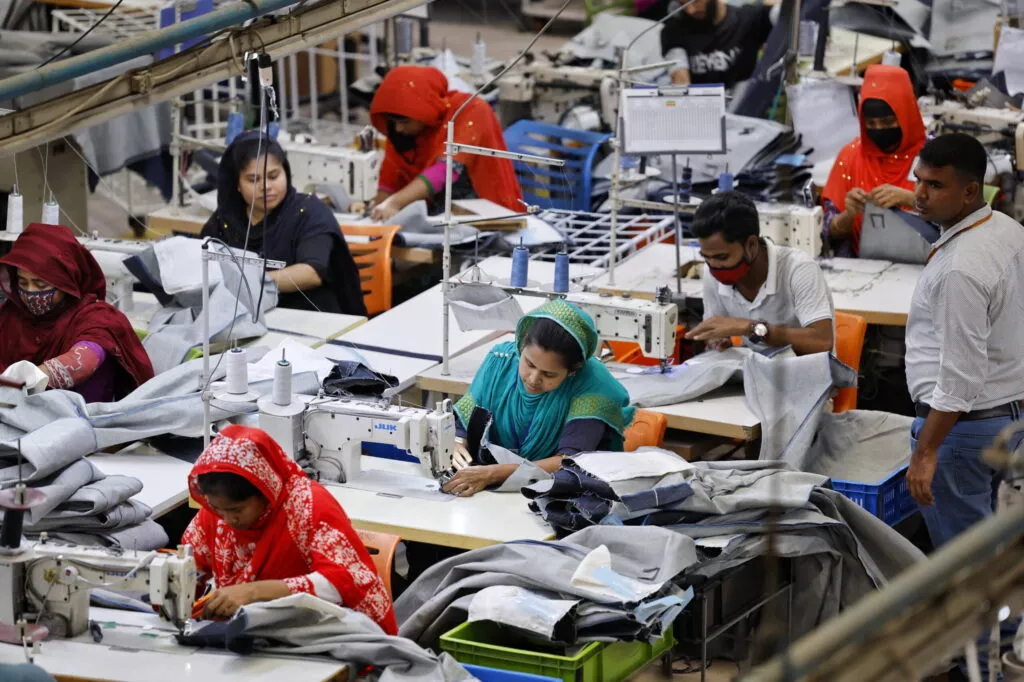
Bangladesh’s export performance since the 1990s has been exemplary, consistently posting double-digit growth rates. This success has rested overwhelmingly on a single product group — ready-made garments (RMG). As Bangladesh approaches graduation from least developed country (LDC) status in 2026, its economy is acutely exposed to sector-specific shocks and eroding trade preferences.
Bangladesh’s development story is widely recognised as a success. Real GDP growth has averaged around 6 per cent annually since 2000, manufacturing now accounts for roughly a quarter of GDP and exports have risen from US$6.6 billion in 2000 to US$47.1 billion in 2024. RMG alone makes up 81 per cent of exports, translating to around 7 per cent of global market share and positioning Bangladesh as the world’s second largest garment exporter.
Underpinning this performance was pragmatic policy architecture. In a high-tariff economy, apparel exporters were allowed to operate at global prices through duty-free access to imported inputs, while back-to-back letters of credit aligned financing with export orders and green-channel customs clearance reduced delays and uncertainty. These measures, along with broader trade reforms in the 1990s like tariff rationalisation, import liberalisation and exchange rate flexibility, created a quasi-free trade enclave for garments.
But while RMG exporters functioned essentially under free trade, most other sectors remained trapped under a complex and protective tariff regime that incentivised domestic sales. Despite successive export policies, priority sector lists and cash incentives, export concentration has only deepened.
Agriculture’s share of GDP has fallen from around 60 per cent in 1971 to 11.2 per cent in 2024. And while industry’s share of GDP has risen to 34.1 per cent, manufacturing makes up 25 per cent compared to 11 per cent in 1980. While manufacturing performance compares favourably with global and LDC averages and there is no evidence of premature deindustrialisation, this transformation has been powered by a single export engine.
Non-RMG exports have risen only modestly, from approximately US$1 billion in the early 1990s to just over US$8 billion by 2023, while RMG exports surged to approximately US$38 billion in the same period. Bangladesh remains more product- and market-concentrated than most regional peers, despite sizeable unrealised export potential in nearby markets like India, China and Southeast Asia.
The common explanation for Bangladesh’s weak diversification is lack of competitiveness, but research using revealed comparative advantage shows that a large majority of Bangladesh’s non-RMG exports like footwear are already highly or moderately competitive in global markets.
The binding constraint on export diversification is not demand or capability, but the anti-export bias embedded in Bangladesh’s trade policy. Exorbitant tariff protection rates accorded to import-competing industries systematically discourages exports in favour of import substitution. High tariffs on final goods are reinforced by para-tariffs and steep tariff escalation, raising effective protection for domestic sales and decisively tilting incentives towards serving the home market.
For most non-RMG producers, selling domestically remains more profitable than exporting even where comparative advantage exists — not because exporters lack competitiveness, but because inward-looking policies and regulations actively disincentivise international trade. Export subsidies of up to 10 per cent in 2025–26 are simply no match for average nominal protection rates that often exceed 40 per cent.
While duty- and quota-free access and flexible rules of origin has underpinned Bangladesh’s export growth, graduation from LDC status will narrow preference margins, tighten compliance requirements and expose exporters to most favoured nation tariffs, unless alternative agreements are secured.
The European Union will be pivotal, while markets such as Canada, India, Japan and China will also see changes in access conditions. Exports to the United States, which offers no LDC scheme, will be less affected — the reciprocal tariff scheme may even provide a modest relative advantage for Bangladesh.
Sustained export growth now depends on policy-driven competitiveness. The most direct response is to replicate the operating conditions that powered RMG success by rule rather than exception. This means universal, rules-based duty-free access to imported inputs for all export production, standardised back-to-back trade finance, streamlined border clearance and a transparent, digital and fast-paced duty-drawback system.
Phasing out para-tariffs, compressing tariff bands and shifting revenue reliance towards broader, trade-neutral domestic revenue sources — such as value added tax and income tax — would also neutralise anti-export bias while safeguarding fiscal revenues.
These domestic reforms must be complemented by investments in standards, testing and certification, improved logistics and trade finance and increased foreign direct investment. A more strategic approach to trade agreements is also necessary, which could involve pursuing the EU Generalised Scheme of Preferences Plus and deepening integration with Asian value chains through bilateral or regional free trade agreements.
Bangladesh’s graduation from LDC status validates five decades of progress, but it will also test whether the policy settings that delivered this growth can sustain competitiveness without preferential cushions. If anti-export bias is neutralised and the RMG model is extended economy-wide, graduation can act as a springboard for broader, more resilient export-led growth. If not, export concentration risks rising further, leaving the economy more vulnerable in an increasingly uncertain global trade environment.
Zaidi Sattar is Chairman at the Policy Research Institute, Bangladesh.
Hasan Al Banna is Senior Research Associate at the Policy Research Institute, Bangladesh.